Injection site reference guide
GLP-1 Injection Site Tracker
A practical guide for organizing injection locations, site rotation, dose history, missed doses, and notes you may want to review later.
Uses official label information as reference context. Does not recommend doses or replace clinician instructions.
What to write down
Small details matter
Keep only the details that make the history easier to read later. Everything else belongs on your prescription label, Medication Guide, or with your clinician.
Date/time
When you actually injected.
Dose
The dose administered.
Site
Body region plus side or landmark when useful, such as right abdomen or left outer thigh.
Reaction note
Any irritation or question to discuss.
Missed/late note
If the dose did not happen on schedule.
Site zones
Injection site zones
Your label or clinician is the source of truth. For tracking, these landmarks help keep the site record specific enough to review later.
| Site | Injection site | Why record it |
|---|---|---|
| Abdomen | Belly area between the ribs and hip bones, avoiding the area around the navel. | Helps you rotate within a large visible area, such as left/right or upper/lower abdomen. |
| Outer thigh | Front-outer thigh, roughly between a hand's width below the hip and above the knee. | Helps connect the dose record with leg soreness, training days, or other context you may want to review. |
| Back upper arm | Fleshy back-of-arm area between shoulder and elbow, if your instructions include it. | Helps remember which arm was used, especially when someone else helped with the injection. |
| Upper outer buttock | Upper outer quadrant, only if appropriate for your product or clinician-directed routine. | Helps keep peptide-site notes separate when the area is harder to see or inspect later. |
Skip irritated skin
Avoid bruised, tender, inflamed, broken, hot, swollen, or increasingly painful areas.
Skip changed tissue
Ask about scars, tattoos, moles, stretch marks, lumps, or unusually firm areas before using them.
Skip rubbing zones
Waistbands or tight clothing can rub the site afterward and make notes harder to interpret.
Absorption notes
Why one site can feel different from another
Subcutaneous medicine moves out of the tissue partly through local blood flow. That does not mean you should chase a "faster" site. It means site notes can help explain a week that felt different.
Abdomen, thigh, arm
Some subcutaneous medicines absorb faster from the abdomen, but GLP-1 and tirzepatide labels still direct people to use labeled sites and rotate as instructed.
Exercise
Heavy use of the injected area can increase local blood flow. If you inject into a thigh before a hard leg workout, that context may be worth noting.
Heat
Heat can increase blood flow near the skin. A hot shower, sauna, or heating pad close to the injection time may be useful context if the day feels unusual.
Rubbing
Unless your instructions say otherwise, do not massage the site. If you see a small bead of blood, light pressure with clean gauze is different from rubbing.
Timing, not dose
These details can affect how a dose feels over time. They are not a reason to change the amount, schedule, or medical instructions.
Common questions
GLP-1 injection site questions worth answering clearly
Short answers for common tracking questions. For medical decisions, use your prescription label, Medication Guide, pharmacist, or clinician.
Many GLP-1 labels describe abdomen, thigh, or upper arm. Some peptide routines may use other subcutaneous areas. Follow the exact instructions that came with your product or prescription.
For products that allow abdomen injections, people commonly track the belly area between the ribs and hip bones while avoiding the area around the navel. Follow your label or clinician's instructions.
Avoid logging or reusing areas that are bruised, tender, inflamed, broken, lumpy, unusually firm, or directly under repeated clothing friction. Ask a clinician about scars, tattoos, moles, or any site reaction.
It can affect absorption rate for some subcutaneous medicines because local blood flow varies by tissue and activity. For GLP-1 tracking, treat this as context for your history, not a reason to change dose or schedule.
Some subcutaneous-injection literature describes faster absorption from the abdomen for certain medicines. Tirzepatide labeling reports similar exposure across abdomen, thigh, and upper arm, so follow your product label and use site notes only as tracking context.
Exercise can increase blood flow in the working area. If you inject into a thigh before a hard leg workout, logging that context can help you interpret the week later.
Heat can increase blood flow near the skin. If a hot shower, sauna, or heating pad happens close to the injection time, it may be worth recording as context.
Do not massage the site unless your medication instructions or clinician tell you to. If there is a small bead of blood, follow your product instructions; many references describe light pressure rather than rubbing.
A site log helps you review rotation, irritation notes, and administration history later.
Use the level of detail that is useful: body region may be enough, or you may track side/location if rotation matters.
No. Follow your medication guide, prescription label, pharmacist, or clinician.
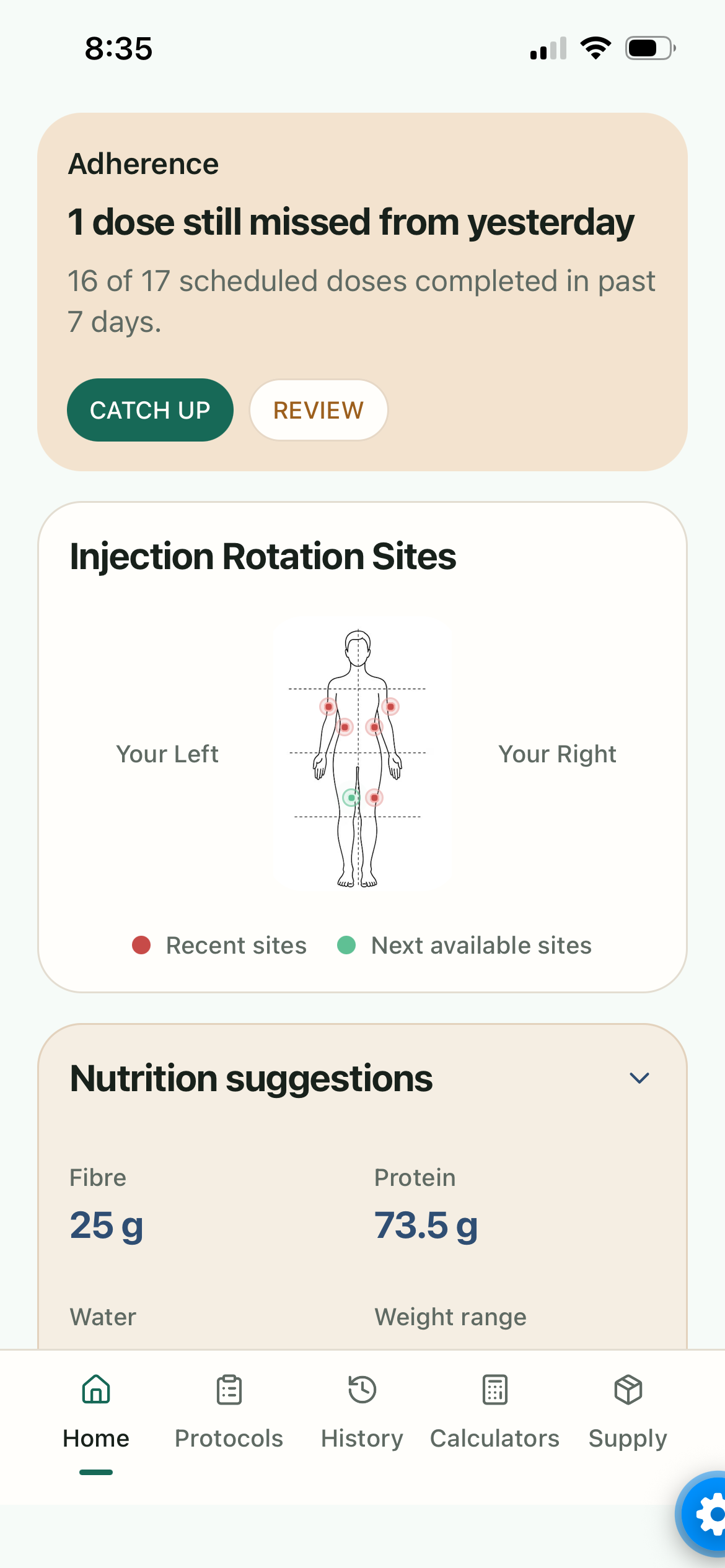
Protocolit keeps injection site history tied to the dose timeline.
Built for this
Keep it all together with Protocolit
Protocolit is built to keep your protocols, dose administrations, titrations, missed doses, injection sites, supply, expiration dates, and weight trends together. Leave the routine to us, so you can focus on the journey.