Clean both stoppers
Wipe the bacteriostatic water vial and peptide vial with alcohol before puncturing either one.
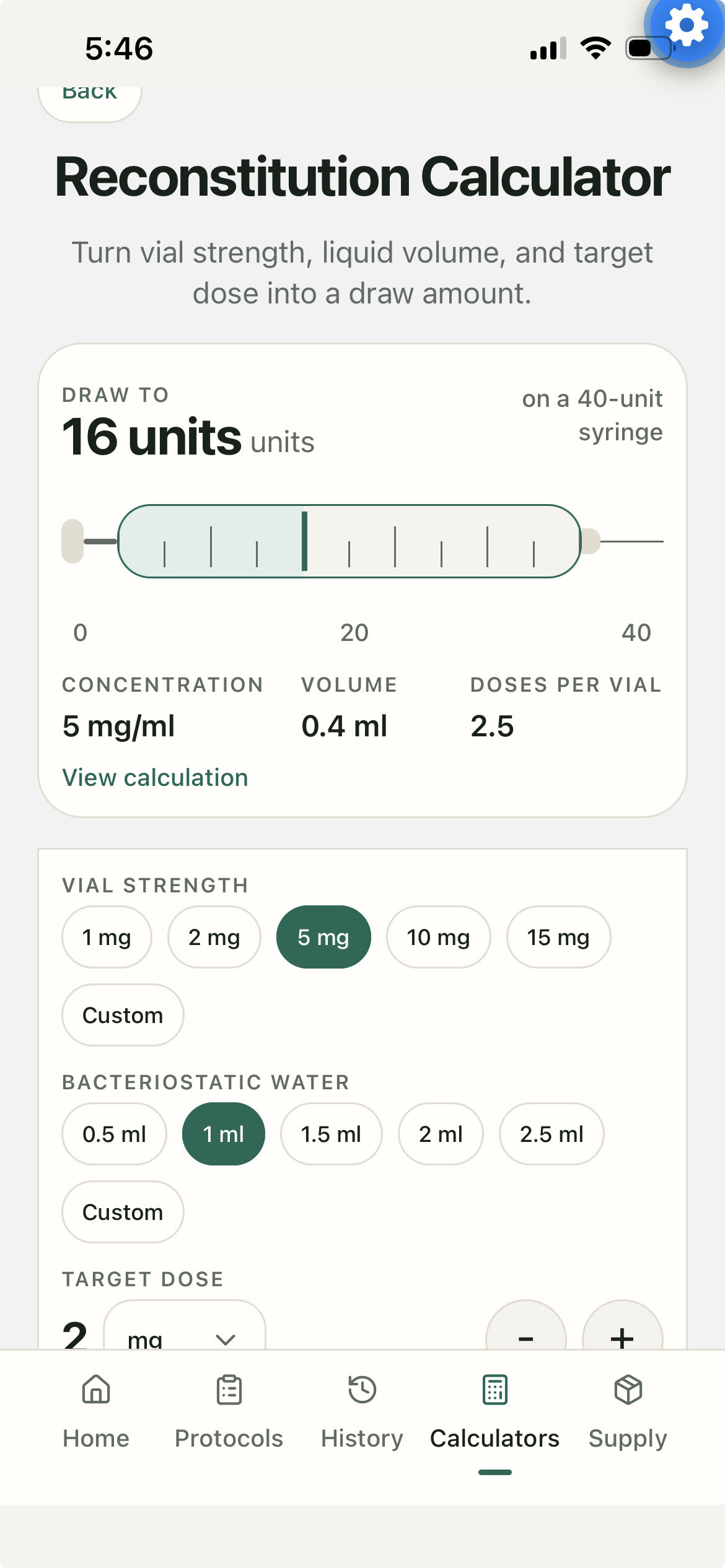
Reconstitution calculator
Use this peptide dosage calculator for reconstituting peptides: convert vial strength, bacteriostatic water, and target dose into concentration, mL to draw, U-100 syringe units, and doses per vial.
Use this calculator when you know the vial strength and the amount of bacteriostatic water. If your label already gives mg/mL for semaglutide or tirzepatide, use the individual mg-to-units calculator instead.
Total medication amount listed for the vial.
Use the amount your label or pharmacist told you to add.
The dose you are checking against the vial math.
Choose the markings on the syringe you actually have.
On a U-100 syringe.
For general education only. This is not medical advice or a treatment recommendation, and it does not choose a dose, choose how much liquid to add, or replace the prescription label, pharmacist, clinician, or pharmacy instructions.
Highlighted at 40 units on a U-100 syringe.
Concentration
5 mg/mL
Volume
0.4 mL
Doses per vial
5
10 mg / 2 mL = 5 mg/mL. 2 mg / 5 mg/mL = 0.4 mL. 0.4 mL x 100 = 40 U-100 units.
Reconstituting your vial
Reconstitution is adding liquid, almost always bacteriostatic water, to a freeze-dried or lyophilized peptide so the final solution can be measured.
Use the diluent, water volume, storage directions, and beyond-use date from the prescription label, pharmacy, product instructions, or licensed provider.
Wipe the bacteriostatic water vial and peptide vial with alcohol before puncturing either one.
Pull the prescribed amount of bacteriostatic water into the syringe before adding anything to the peptide vial.
Aim the stream down the inside wall of the peptide vial instead of blasting the powder directly.
Roll or swirl the vial until the powder dissolves. Do not shake it hard.
Keep the reconstituted vial cold and protected from light unless your prescriber or pharmacy gives different storage instructions.
Your peptide dissolves evenly in the water you add, so the concentration is the total peptide in the vial divided by the water volume. U-100 insulin syringes are marked so that 100 units equal 1 mL. Get your target dose from a licensed provider; this calculator handles the arithmetic, not the protocol.
vial mg / bacteriostatic water mL = mg/mL
(target mcg / (vial mg x 1000)) x water mL x 100 = U-100 units
(vial mg x 1000) / target mcg, rounded down
Starting points, not recommendations. These examples show common arithmetic patterns only. Set your actual vial amount, water volume, and target dose with a clinician or pharmacy.
| Peptide | Vial | BAC water | ConcentrationStrength | Example draw |
|---|---|---|---|---|
| BPC-157 | 5 mg | 2 mL | 2.5 mg/mL | 0.25 mg = 10 units |
| TB-500 | 10 mg | 3 mL | 3.3 mg/mL | 2 mg = 60 units |
| Ipamorelin | 5 mg | 2 mL | 2.5 mg/mL | 0.2 mg = 8 units |
| CJC-1295 | 2 mg | 2 mL | 1 mg/mL | 0.1 mg = 10 units |
| Sermorelin | 5 mg | 2 mL | 2.5 mg/mL | 0.2 mg = 8 units |
| Tesamorelin | 10 mg | 2 mL | 5 mg/mL | 1 mg = 20 units |
CALCULATOR FAQs
It uses vial strength, liquid volume, target dose, and syringe type to estimate concentration, mL to draw, syringe units, and doses per vial.
Yes. It is a reconstituting peptides calculator for converting vial strength, bacteriostatic water volume, and target dose into concentration, mL to draw, syringe units, and doses per vial. It does not recommend a dose or choose how much liquid to add.
It means adding the specified liquid to a freeze-dried or lyophilized peptide so the final solution can be measured. The required diluent, volume, storage, and discard date should come from the label, pharmacy, or prescriber.
Bacteriostatic water is sterile water that includes a preservative, commonly benzyl alcohol. Use it only when the product instructions, pharmacy, or prescriber specify it.
Do not treat diluents as interchangeable. Sterile water has no preservative and saline contains salt; follow the diluent named by the product labeling, pharmacy, or prescriber.
No. Use the amount provided by your prescription label, vial instructions, pharmacist, or clinician. The calculator checks the math after you enter that amount.
The vial still contains the same total amount. More water spreads that amount through more liquid, lowering concentration, so the same dose requires more mL and more syringe units.
That depends on the vial amount, liquid volume, target dose, and syringe units-per-mL. Enter those label and prescription details into the calculator to estimate the unit mark.
1 mg equals 1,000 mcg. A 5 mg vial contains 5,000 mcg before reconstitution math.
Some syringes are marked in units. A U-100 syringe has 100 units per mL, while a U-40 syringe has 40 units per mL, so the same mL volume maps to different unit marks.
Choose the syringe type or units-per-mL that matches the syringe you actually have. For the same U-100 scale, smaller barrels can make small doses easier to read, but the unit math is the same.
Do not change the prescription or reconstitution plan on your own. Ask your pharmacist or clinician how to handle rounding, syringe choice, or a different dilution.
Storage time depends on the specific product and pharmacy instructions. Follow the label, beyond-use date, and storage guidance for that vial.
Use the total peptide amount stated on the vial label, usually in mg. If the label is unclear or lists only a concentration, confirm the correct entry with the pharmacy or prescriber.
No. It is for general education only and is not medical advice or a treatment recommendation. Talk to a qualified healthcare professional before starting, stopping, or changing any peptide, medication, or supplement.
For concentration-first vial math, use the tirzepatide units calculator or semaglutide units calculator. If you missed a dose or have questions about changing the time/day of dose, use the missed-dose guide.
Built for this
Protocolit keeps protocols, dose administrations, titrations, missed doses, injection sites, supply, expiration dates, weight trends, and calculator references together. Leave the routine to us, so you can focus on the journey.